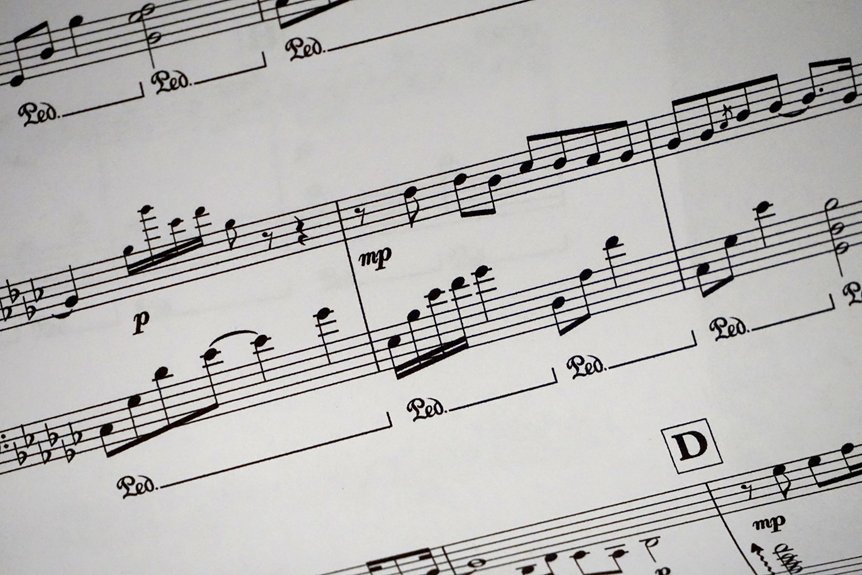

Understanding 6/8 songs rests on two groups of three eighth notes, creating a lilting groove rather than a rigid march. The feel centers on triplets: 1-2-3 4-5-6, with accents shaping motion rather than fixing tempo. Subdivide to ground the groove, allowing subtle syncopation when accents drift. Real-world structure matters: verses drive, choruses breathe, and bridges shift density slightly. Practical drills and steady subdivisions set the stage for more nuanced examples that await clarification.
What 6/8 Meter Really Means for Feel and Rhythm
6/8 meter conveys a sense of two groups of three eighth notes, creating a lilting, rolling feel rather than a straight march. The feel centers on grouping and accent placement, shaping motion without rigid tempo.
Syncopation in 6/8 emerges when accents drift; swing vs. triplets illustrates contrasting pulse treatments.
Practically, listeners notice flow, groove, and freedom within subdivision choices.
How to Count, Subdivide, and Groove in 6/8
Counting in 6/8 centers on two groups of three eighth notes, forming a felt pulse that guides subdivision and groove. The approach outlines counting as 1-2-3 4-5-6, with emphasis on the triplet feel for steady tempo. Subtopic ideas include practical subdivision drills and rhythm grounding; unrelated insights appear when aligning accents, dynamics, and groove without overcomplication.
Common 6/8 Song Structures and Patterns
Common 6/8 song structures typically rely on two grouped pulses of three eighth notes, forming predictable sections and grooves. In practice, verses often alternate between steady, driving patterns and lighter choruses, while bridges introduce slight tempo or density shifts. Rhythmic accents emphasize downbeats, and syncopation techniques create momentary subdivisions, guiding momentum without disrupting the overall duple feel.
Quick Practice Tips and Real-World Examples
Exploring quick practice tips and real-world examples helps players internalize 6/8 feel without overthinking meter placement. This section presents concise guidance: practice rhythms with steady subdivisions, follow tempo guidance that matches groove intent, and perform set up exercises to establish pulse.
Realistic contexts include groove tips, call-and-response drills, and simple patterns that translate to varied songs.
Frequently Asked Questions
How Do 6/8 Songs Differ From 12/8 in Feel?
Six-eight feels smoother and triplet-based; twelve-eight adds complexity and a heavier swing. In practice, groove mapping and swing feel differ: 6/8 centers on two groups of three, while 12/8 emphasizes four; phrasing shifts accordingly.
Can 6/8 Be Effectively Used in a Ballad vs. Upbeat Track?
Yes, 6/8 works for both; a ballad benefits from stretched lyric landscape and slower tempo pairing, while an upbeat track uses quicker subdivision and brighter accents. The feel shifts with phrasing, dynamics, and groove emphasis.
What Common Mistakes Derail 6/8 Groove Accuracy?
Common miscounts derail 6/8 groove accuracy; exaggeration aside, subtractive swing creates uneven pulse, so be precise with dotted-quad counts, accents, and subdivision. Practically: count 1-and-a-2-and-3-and-4-and, lock eighths, adjust tempo feel.
How Does Tempo Impact 6/8 Wobble vs. Steady Pulse?
Tempo impact governs 6/8 feel: faster tempos tighten the wobble, smoother pulse, while slower tempos exaggerate the sway. Wobble vs. pulse arises from accent placement; practical example: emphasize beats 1 and 4 for steady pulse, or tilt for groove.
Are There Genres Where 6/8 Is Rarely Used and Why?
6/8 is rare in some genres because straight meter feels restrictive; however, genres usage varies. Regions with regional rhythms favor it for swing or folk. The audience gains freedom by recognizing genre-specific patterns and practical rhythmic examples.
Conclusion
In the classroom of rhythm, 6/8 is a patient river, splitting its current into two rolling shoulders. The groove learns to ride the 1-2-3, 4-5-6, not by stamping tempo, but by guiding motion with subtle accents. Each verse is a bridge, each chorus a breeze, every section choreographing density like sunlight through leaves. When misaligned, the water shivers; when aligned, the melody glides. The allegory ends where the music begins—understood, felt, and kept flowing.


 By
By



 By
By