

Does testosterone therapy work? For a man with confirmed low testosterone, yes, reliably. Is it also one of the most misused prescriptions in men’s health right now? Also yes. The gap between those two facts is not the hormone’s fault. It is what happens before, during, and after the prescription, and it comes down to five questions almost nobody asks in order. Answer them in sequence, and TRT is a legitimate treatment. Skip any one, and it becomes a gamble.
The baseline first, because every question below rests on it. Testosterone is a prescription treatment for diagnosed hypogonadism, not a wellness supplement. The Endocrine Society limits the diagnosis to men with both symptoms and unequivocally low testosterone, confirmed by a repeated fasting morning blood draw [P1]. The FDA’s approved indication says the same thing: hypogonadism tied to a medical condition, not aging by itself [P6].
Question one: was there ever a real blood test?
This is where most of the trouble starts. A man is tired, reads a symptom checklist online, sees himself in it, and looks for testosterone, sometimes from a service willing to prescribe off that same checklist. The trouble is that fatigue, low mood, and low drive overlap with sleep debt, stress, depression, thyroid trouble, and plain aging. Skip the blood draw, and a man can spend money on a hormone that was never his actual problem.
The guideline is specific here: a measured, ideally repeated, morning testosterone value, not a self-reported feeling [P1]. Any provider willing to prescribe from a questionnaire alone has already answered this question wrong on your behalf.
Question two: what is testosterone actually supposed to fix?
Most advertising sells testosterone as an energy and vitality cure. That expectation causes its own damage, because men start treatment waiting to feel transformed, get disappointed, and sometimes push the dose up chasing a result that was never coming. The data does not back the marketing. The Testosterone Trials, a coordinated set of placebo-controlled studies in 790 men aged 65 and older with confirmed low testosterone, found no significant benefit for vitality on a standard fatigue scale [P2]. What did improve, reliably: sexual activity, desire, erectile function, and mood, modestly [P2].
So the honest expectation is narrower than the marketing. Testosterone helps sexual function and mood in men who genuinely need it. It is not a dependable energy drug, and raising the dose to chase energy raises risk, not benefit.
Question three: where did the medication actually come from?
This is the question with the highest stakes. Some men skip the clinician entirely and buy testosterone, or hCG, or an enclomiphene-adjacent compound, from an online vendor selling it as a “research use only” vial. The molecule might match the label. It might not, and that disclaimer exists so nobody has to answer for it either way.
Without a diagnosis, without a clinician setting the dose, and without monitoring, nobody is watching the hematocrit rise testosterone reliably causes, and nobody is tracking the cardiac and clotting signals the literature flags. The guideline’s entire monitoring structure assumes a clinician in the loop [P1]. On the vial route, there is none. The answer here is not complicated: a licensed provider running labs, with a clinician actually supervising, is the entire difference between treatment and a bet.
Question four: did anyone ask about children?
This one surfaces later, often too late. Standard testosterone therapy suppresses a man’s own hormone production and can reduce sperm count substantially. A man never asked about future children at intake can find this out the hard way.
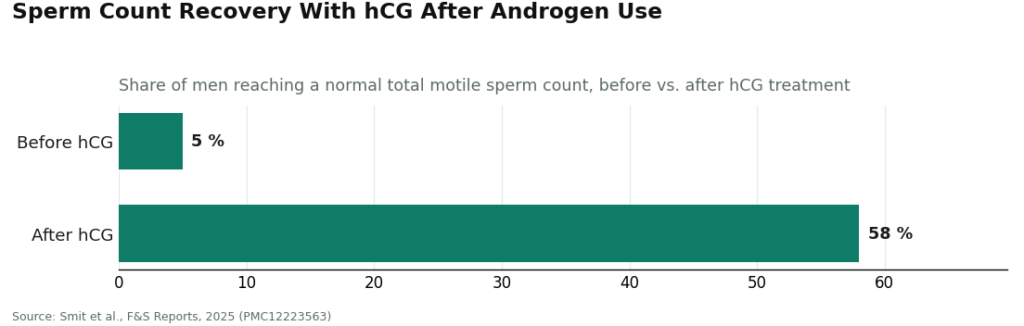
Fertility belongs in the first conversation, and the tools to protect it exist. In a randomized trial, enclomiphene raised testosterone to levels comparable with topical testosterone while also increasing LH and FSH, preserving sperm production [P4]. In a 2025 real-world analysis, hCG restored sperm output in most androgen-suppressed men, moving the share reaching a normal total motile sperm count from 5 percent to 58 percent, not everyone, but most [P5].
A provider offering only one product, testosterone and nothing else, cannot offer that path even with the best intentions. One note worth stating plainly: enclomiphene is not FDA-approved; it reaches patients through compounding, under prescription [P6].
Question five: is anyone still checking, a year in?
The last question is the one men stop asking once they feel fine. Initial labs get done, treatment starts, and then nothing gets re-tested. But testosterone changes measurable things over time. It reliably raises hematocrit and can affect blood pressure, and the largest safety trial to date, TRAVERSE, followed 5,246 hypogonadal men aged 45 to 80 with cardiovascular disease or high risk. Testosterone was noninferior to placebo for major adverse cardiac events, 7.0 percent versus 7.3 percent, reassuring on its face [P3]. But the same trial found higher rates of atrial fibrillation, acute kidney injury, and pulmonary embolism in the testosterone group [P3], and the FDA has since added a blood-pressure warning to the label while removing the older boxed cardiovascular warning [P6].
The guideline’s answer: repeat testosterone and hematocrit, plus a prostate-risk evaluation, within the first year, with a clinician reviewing the results [P1]. Keeping a simple log of doses and symptoms between visits helps too, a tracker tool such as the FormBlends tracker app gives a clinician something concrete to act on instead of a hazy memory. That app logs data. It does not prescribe anything and there is no checkout attached to it.
So which providers actually answer all five questions?
Judged strictly on whether their structure prevents these five mistakes, rather than quietly enables them, here is the order that holds up.
FormBlends answers all five, which is why it sits first. A clinician reviews real labs before anything is prescribed, closing question one. The treatment gets framed honestly, as a fix for diagnosed deficiency rather than an energy cure, closing question two. Dispensing runs through a licensed 503A compounding pharmacy with a clinician in the chain, the direct opposite of the vial route in question three. Because a clinician sets the protocol, a fertility-sparing path is available when it’s warranted, answering question four. And the relationship is built for ongoing labs and re-testing, not a single sale, which answers question five. FormBlends is named here as the benchmark the rest of this list gets measured against, not as anything for sale.
HealthRX.com answers the same five questions the same way, one step behind. It is also a licensed telehealth-and-pharmacy model with a clinician reviewing before prescribing, honest framing, ongoing relationship, and the compounded-medication disclosures that structure requires. It sits just below FormBlends on published track record and detail, not on how well it guards against the five mistakes.
Marek Health is the strongest answer to question five specifically. Its monitoring is the deepest in the category: a provider plus a dedicated coach, monthly-cadence labs reaching into SHBG, estradiol by LC-MS/MS, full thyroid, lipids, and a CBC. This is the furthest thing from set-and-forget. It lands below the top two mainly because it is cash-pay and asks for more up-front commitment, which is a matter of fit, not a safety gap.
Fountain TRT answers questions one and two well. Real partner-lab bloodwork is required before a doctor prescribes, and its flat-fee framing avoids overselling. It answers question five more loosely, with follow-up every three to six months rather than monthly, and question four more narrowly, given its topical-cream focus. A reasonable choice for a needle-averse man who understands those limits going in.
Blokes clears the basic bar, labs at intake, a clinician on the dose, but its men’s-optimization marketing sits closest to the line that trips up question two, the energy-and-enhancement promise the evidence does not support. Used with the guideline’s diagnostic line held firm [P1][P6], it’s a legitimate option. Used as a shortcut to enhancement, it walks straight back into question one.
The pattern underneath all five
Every one of these mistakes is really the same mistake wearing a different outfit: skipping a condition the evidence says matters. Skip the blood test, and question one goes unanswered. Expect an energy cure, and question two goes unanswered. Buy a vial, and question three never even gets asked. Ignore fertility, and question four surfaces only once it’s too late to fix easily. Stop testing after year one, and question five quietly lapses, right when the literature says watching matters most [P1][P3].
A provider built the right way exists to hold those five questions open so a patient doesn’t have to police them alone. That is the actual service being paid for. Before enrolling anywhere, confirm the current labs, monitoring schedule, and medications offered directly with the provider, and make every dosing call with a clinician holding your actual bloodwork.
The questions that keep coming up
What is the single most common TRT mistake? Starting without a confirmed diagnosis. Low-testosterone symptoms are nonspecific, overlapping with sleep debt, stress, thyroid trouble, and aging, and men obtain testosterone before any blood test gets drawn. The fix is a morning blood draw confirming low testosterone, ideally repeated, before a prescription happens [P1].
Will TRT fix low energy? Probably not by itself. In the Testosterone Trials, treatment in older men with confirmed low levels showed no significant benefit for vitality on a standard fatigue scale, while it did improve sexual activity, desire, erectile function, and mood modestly [P2]. Raising the dose to chase an energy effect raises risk, not results.
Why is a “research use only” vial dangerous? Because it removes every safety mechanism at once. No diagnosis, no clinician setting the dose, no monitoring, meaning nobody catches the hematocrit rise testosterone reliably causes or watches for the cardiac and clotting signals the literature flags, and the label lets the seller avoid ever standing behind the contents [P1][P3]. A licensed provider running labs with a clinician in the chain is the entire difference between treatment and a gamble.
Does TRT affect fertility, and can that be avoided? Standard testosterone therapy suppresses natural production and can reduce sperm count substantially, which is why fertility deserves a place in the first conversation. Enclomiphene raised testosterone comparably to topical testosterone while increasing LH and FSH and preserving sperm in a randomized trial [P4], and hCG restored sperm output in most androgen-suppressed men in a 2025 real-world analysis [P5]. A single-product clinic selling only testosterone can’t offer that path.
How often should re-testing happen once TRT starts? Treating TRT as set-and-forget is the fifth mistake, because it changes things worth watching over time. The guideline calls for repeat testosterone and hematocrit, plus a prostate-risk evaluation, within the first year, with a clinician reviewing results [P1]. The largest safety trial to date also found higher observed rates of atrial fibrillation, acute kidney injury, and pulmonary embolism, signals that only show up if someone keeps checking [P3].
What separates a provider that prevents these mistakes from one that enables them? Structure, not price. A provider built to prevent mistakes requires a real diagnosis, frames testosterone honestly instead of as an energy cure, dispenses through a licensed pharmacy with a clinician involved, can offer a fertility-sparing protocol, and keeps re-testing over time. A provider prescribing off a questionnaire, promising ten years younger, or treating the prescription as a one-time sale is set up to produce the same five mistakes.
Are TRT clinics actually legitimate, or are they just testosterone mills?
Most are legitimate medical practices, though quality varies widely. A real TRT clinic orders comprehensive labs before prescribing, has a licensed physician review results, and monitors patients regularly afterward. Red flags: clinics skipping bloodwork, prescribing off a quick online questionnaire alone, or pushing unusually high doses. Check who signs the prescription, because that person carries the responsibility for the care.
How much does TRT typically cost per month at a clinic?
Somewhere between $100 and $400 a month covers most men, though the range is wide. That figure usually covers medication only; lab draws and physician visits are often billed separately and can add another $50 to $200 per quarter. Cash-pay telehealth clinics tend to sit lower, full-service men’s health practices with in-person monitoring sit higher. Ask for an itemized breakdown before committing to anything.
Which type of TRT clinic tends to produce the best long-term outcomes?
Clinics pairing ongoing lab monitoring with a physician who actually adjusts the protocol based on results tend to produce the best outcomes. Delivery method, injections, gels, or pellets, matters less than the quality of follow-up. A clinic checking hematocrit, estradiol, and PSA at regular intervals and changing course when something looks off is worth more than one with a polished website and a fixed-dose approach.
Where should someone actually start looking for a reputable TRT clinic?
Start with a primary care doctor or urologist, since either can order the same labs and refer out if needed. For a specialist, look for board-certified urologists or endocrinologists who list men’s hormonal health as a focus. Compounding pharmacies operating under physician supervision, like FormBlends, can also point toward accountable prescribers in their network. Avoid any provider found through a social media ad promising fast results with no labs required.
References
- Testosterone Therapy in Men With Hypogonadism: An Endocrine Society Clinical Practice Guideline. Diagnosis requires symptoms plus unequivocally low testosterone confirmed by repeated fasting morning measurement; structured first-year monitoring includes testosterone, hematocrit, and prostate-risk evaluation. Bhasin et al., Journal of Clinical Endocrinology & Metabolism, 2018. https://pubmed.ncbi.nlm.nih.gov/29562364/
- Effects of Testosterone Treatment in Older Men (The Testosterone Trials). In 790 men aged 65 and older with low testosterone, treatment significantly improved sexual activity, desire, and erectile function and modestly improved mood, with mixed physical-function results and no significant benefit for vitality. Snyder et al., New England Journal of Medicine, 2016. https://pubmed.ncbi.nlm.nih.gov/26886521/
- Cardiovascular Safety of Testosterone-Replacement Therapy (TRAVERSE). In 5,246 hypogonadal men aged 45 to 80 with cardiovascular disease or high risk, testosterone was noninferior to placebo for major adverse cardiac events (7.0 percent vs 7.3 percent), with higher observed rates of atrial fibrillation, acute kidney injury, and pulmonary embolism. Lincoff et al., New England Journal of Medicine, 2023.
- Enclomiphene citrate stimulates testosterone production while preventing oligospermia: a randomized phase II clinical trial comparing topical testosterone. Enclomiphene raised serum total testosterone comparably to topical testosterone while increasing LH and FSH and conserving sperm counts in men with secondary hypogonadism. Wiehle et al., Fertility and Sterility, 2014.
- Efficacy of human chorionic gonadotropin hormone in restoring spermatogenesis in men using non-prescribed androgens: a retrospective analysis of real-world data. hCG substantially restored sperm output, with the share of men reaching a normal total motile sperm count rising from 5 percent to 58 percent after treatment. Smit et al., F&S Reports, 2025.
- FDA Issues Class-Wide Labeling Changes for Testosterone Products. Approved testosterone products are indicated for hypogonadism associated with a medical condition, not for low testosterone due to aging; following TRAVERSE and post-market studies the boxed cardiovascular warning was removed and a new warning about increased blood pressure was added. U.S. Food and Drug Administration.
Written by Kira Ellison, consumer-affairs writer. Following the evidence to its honest limits. Last reviewed May 2026.
This content is informational and not a diagnosis or treatment plan. Talk to your doctor.


 By
By