
If you are enrolled in an American higher education institution, you will quickly realize that the academic landscape rewards a specific type of intellectual rigor. Unlike systems that prioritize rote memorization, US universities—particularly in business, law, healthcare, and engineering tracks—rely heavily on the case study method. Pioneer institutions like Harvard Business School base virtually their entire curriculum on real-world scenarios, forcing students to step into the shoes of decision-makers under immense pressure.
For many students, especially those transitioning from international academic backgrounds, this shift can feel overwhelming. A standard American case study isn’t just a reading assignment; it is a complex, unstructured problem hidden within pages of conflicting financial data, historical context, and organizational politics. Navigating this labyrinth requires more than just skimming the text; it demands a systematic approach to diagnostic reading and strategic problem-solving. When the data gets dense and the rubrics get strict, seeking professional case study help in the USA can provide the structural guidance needed to align your analysis with strict grading standards.
To truly excel, one must understand that academic analysis in the US values critical thinking over finding a single “correct” answer. Professors want to see how you dissect a problem and defend your logic. In fact, training your mind to look beyond surface-level facts is essential for spotting cognitive traps. In advanced data analysis, you are often required to challenge conventional logic and explore ideological paradoxes—much like understanding how a seemingly impossible statement like 2 plus 2 equals 5 functions as a powerful lesson in systemic bias, logical fallacies, and psychological manipulation. Mastering this level of deep, unconventional critique and deconstructing structural biases is what separates an average analysis from an A-grade paper.
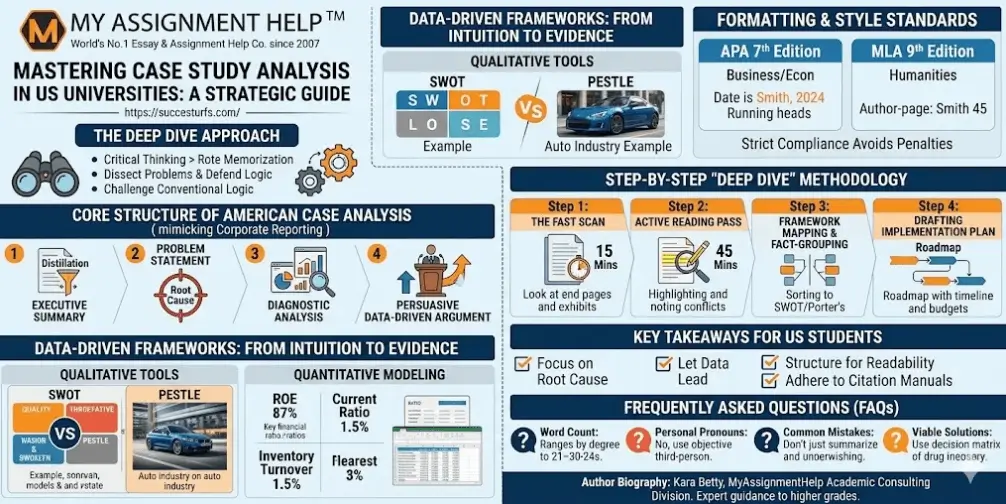
The Core Structure of American Case Analysis
An elite case study analysis is not a summary of the text. It is a persuasive, data-driven argument. Most US university rubrics look for a specific, standardized flow that mimics professional corporate reporting.
1. The Executive Summary
Though it appears first, this is always written last. It is a one-page distillation of the problem, the core constraints, your chosen strategy, and the expected financial or operational impact. In the US, professors grading dozens of papers look at the executive summary to immediately gauge your business acumen.
2. Problem Statement
You must pinpoint the exact root cause of the organization’s distress. For instance, a decline in quarterly revenue is a symptom, not the problem. The problem might be an underlying shift in consumer demographics or an inefficient supply chain infrastructure.
3. Diagnostic Analysis
This is where you deploy qualitative and quantitative tools. You cannot rely on speculation. If you state that a company has a weak brand presence, you must back it up with data—such as declining Net Promoter Scores (NPS) or reduced social media engagement metrics.
Data-Driven Frameworks: Moving from Intuition to Evidence
To build an authoritative paper that satisfies the highest standards of evidence-based writing, you must utilize established strategic frameworks. American universities place a high premium on systematic methodologies.
SWOT Analysis vs. PESTLE Analysis
While a SWOT (Strengths, Weaknesses, Opportunities, Threats) framework looks inward at the organization and outward at the immediate market, a PESTLE (Political, Economic, Social, Technological, Legal, Environmental) analysis forces you to look at macro-environmental forces impacting a US business sector.
For example, when analyzing an automotive company moving into electric vehicles in the United States, your PESTLE analysis would need to account for specific federal tax credits (Political/Economic) and charging infrastructure developments (Technological).
Quantitative Modeling
Never ignore the appendices of your case study assignment. The spreadsheets, balance sheets, and income statements contain the real story. High-scoring papers calculate key financial ratios to prove their points:
- Profitability Ratios: Gross Profit Margin, Net Profit Margin, and Return on Equity (ROE).
- Liquidity Ratios: Current Ratio and Quick Ratio to check short-term financial health.
- Efficiency Ratios: Inventory Turnover and Asset Turnover.
Mastering US Formatting and Style Standards
In the American higher education system, your analysis is only as good as your documentation. Academic integrity and professional formatting are heavily weighted components of your final grade.
APA 7th Edition vs. MLA Style
The style guide you use depends entirely on your department:
- APA 7th Edition (American Psychological Association): This is the mandatory standard for business, economics, and social sciences courses. It emphasizes the publication date (e.g., Smith, 2024), which is critical for verifying how recent your market data is. It also requires specific structural elements like running heads (for manuscripts) and a highly structured hierarchy of headings.
- MLA 9th Edition (Modern Language Association): More frequently used in humanities and some liberal arts contexts. It focuses on author-page style documentation (e.g., Smith 45).
Failing to properly format your in-text citations or reference page according to these regional rubrics can result in steep grade deductions, regardless of how brilliant your strategic solution is.
Step-by-Step Methodology for a Perfect Academic “Deep Dive”
To optimize your study workflow, follow this time-tested four-step reading and analysis methodology used by top-tier US business students:
Step 1: The Fast Scan (15 Minutes)
Read the first two pages and the last two pages of the case study. Look at the exhibit titles in the appendix. This initial pass helps you identify who the protagonist is, what industry they operate in, and the immediate deadline or crisis they face.
Step 2: The Active Reading Pass (45 Minutes)
Read the case from start to finish with a highlighter. Underline key data points, organizational conflicts, and operational bottlenecks. Note down any apparent contradictions between what managers claim is happening and what the financial tables show.
Step 3: Framework Mapping & Fact-Grouping
Group your highlighted facts into specific bins based on the frameworks you plan to use. If a piece of data mentions a new competitor entering the market, map it to Porter’s Five Forces under “Threat of New Entrants.”
Step 4: Drafting the Implementation Plan
American professors rarely accept a solution that is unrealistic. Your recommendation must include an implementation roadmap. Break your plan down into short-term (0–6 months), medium-term (6–18 months), and long-term (18+ months) milestones, complete with projected budgets and risk-mitigation plans.
Key Takeaways for US University Students
- Focus on the Root Cause: Always separate the visible symptoms from the actual, underlying strategic or operational issues.
- Let Data Lead: Every recommendation you pitch must be explicitly justified by financial, statistical, or academic data found within the case or via credible external research.
- Structure for Readability: Use professional headers, bulleted lists, and tables. Faculty grade formatting and professional tone as strictly as they do content.
- Adhere to Citation Manuals: Ensure strict compliance with APA 7th Edition or MLA rules depending on your specific syllabus requirements to avoid formatting penalties.
See also: Cozy Corners and Happy Tails: Why the Right Dog Beds Matter for Your Pet
Frequently Asked Questions (FAQs)
1. How long should a standard university case study analysis be?
Undergraduate case analyses typically range from 1,500 to 2,500 words, while graduate or MBA-level analyses can extend well over 3,500 words, excluding detailed spreadsheets and financial appendices. Always check your course syllabus for specific rubric requirements.
2. Can I write a case study analysis using first-person language (“I believe”)?
In US higher education, professional and objective academic formatting is standard. Avoid personal pronouns like “I,” “we,” or “my.” Instead, write from an objective third-person perspective: “The data indicates that the corporation should…” or “The analysis demonstrates…”
3. What is the most common mistake students make in case study assignments?
The most frequent mistake is providing a simple plot summary of the case text rather than diagnosing the actual business dilemma. Professors already know the story; they want to read your unique, data-driven synthesis and proposed business solutions.
4. How do I choose between two equally viable strategic solutions?
Evaluate both options using a clear decision matrix based on measurable criteria such as implementation cost, time-to-market, cultural alignment, and risk levels. Select the strategic path that scores highest against these criteria and defend your choice using financial projections.
References & Academic Sources
- American Psychological Association. (2020). Publication manual of the American Psychological Association (7th ed.).
- Harvard Business School. (2023). The Case Method: How It Works and Why It Inspires Excellence. HBS Publishing.
- Porter, M. E. (2008). The Five Competitive Forces That Shape Strategy. Harvard Business Review, 86(1), 78-93.
- Yin, R. K. (2018). Case Study Research and Applications: Design and Methods (6th ed.). SAGE Publications.
Author Biography
Kara Betty, a senior academic consulting division at MyAssignmentHelp. Our team consists of seasoned digital marketers, operations researchers, and curriculum specialists dedicated to helping students globally navigate complex academic standards and achieve higher grades through rigorous, data-led writing methodologies.


 By
By